


Project Jazzgame
VEETEE Games
Project Jazzgame caught my attention because it aims for a lively combination: free-running movement, open exploration, and battles against enemies. That mix can easily become messy when movement and combat compete for attention, but VEETEE Games gives the game a clear identity as an adventure title rather than presenting it as a simple arena fighter. After spending time with it, my strongest impression is that its appeal depends on how much you enjoy learning a movement-focused game and turning the environment into part of the challenge.
The game is free to download, which makes it easy to try without committing money first. It is available for players using Android 8.0 or later, carries an Everyone age rating, and has already passed half a million installs. Its average score sits at 4.6 from roughly 5.5 thousand ratings, a healthy sign that the basic idea is connecting with a sizeable audience. I would still approach that rating as an invitation to test the game yourself, because parkour-heavy controls are naturally more personal than a conventional adventure interface.
Project Jazzgame works best when you treat movement as more than a way to travel. Running, jumping, changing direction, and choosing how to approach danger are central to the experience. If you prefer a game that lets you move through a space with energy instead of following a narrow path, there is a good chance the concept will appeal to you. If you want a slow, story-led adventure or a carefully guided combat game, its open-ended style may feel less immediately comfortable.
How the setting, sound, and movement shape the experience
A first session built around curiosity
My first useful test with this game was not to rush directly toward enemies. I spent time observing how the environment invited movement. That matters because an open-world adventure can feel empty when its spaces are only large backgrounds surrounding a mission route. Here, the promise of parkour changes the way I look at the surroundings. A ledge, gap, or alternate route becomes something I mentally measure, even before I know whether it is the safest or fastest option.
This creates a different kind of first impression from a traditional mobile adventure. Many games in the category give you a clear objective, a small set of buttons, and a predictable sequence of encounters. Project Jazzgame instead asks you to build confidence through movement. The early learning curve is therefore less about memorizing a long list of abilities and more about understanding how boldly you can navigate the space without losing control.
Related News






I also found that the game’s central idea is easy to understand without a long explanation. You explore, use parkour to move through the world, and fight enemies when the route becomes dangerous. That simplicity is useful on a phone, where I may only have a short session available. I can start playing quickly and focus on the immediate question of how to reach the next area or handle the next threat.
The trade-off is that a simple premise places more pressure on execution. When a game has a huge inventory, dialogue system, or complex progression structure, those elements can carry a weak moment. Here, the feel of traversal and the timing of encounters have to do more of the work. If movement feels satisfying, the world becomes inviting. If it feels awkward on your device, the same openness can make the experience feel less directed.
Art direction that supports a playable mood
The most interesting part of the presentation is how the visual identity works alongside the movement concept. The setting is not merely decoration; it is the stage on which the game’s main verbs make sense. Parkour needs spaces that encourage quick decisions, and battles need enough room for the player to read danger. When those needs overlap, the environment feels more coherent than a collection of disconnected levels.
Gallery
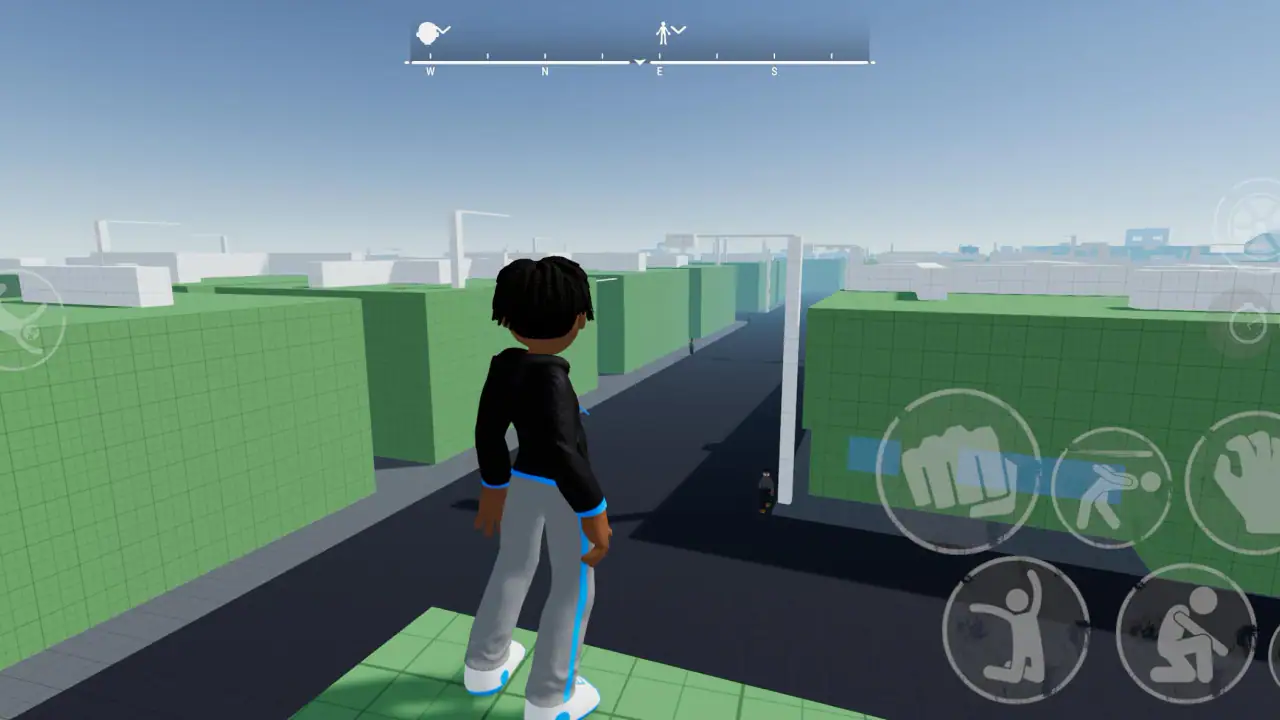
I pay particular attention to whether visual design helps me understand where I can go. In a movement game, readability is more important than visual noise. Strong contrasts, recognizable surfaces, and clear boundaries make a practical difference because I am often looking ahead while controlling the character. A beautiful scene that hides a usable route can be less helpful than a simpler one that communicates its geometry immediately.
That is also where the game’s open-world ambition creates a meaningful compromise. A broad setting can encourage experimentation, but it can also make a player wonder whether a distant location is genuinely relevant or simply part of the scenery. I recommend approaching exploration with a short objective in mind rather than trying to inspect every visible corner in one sitting. This keeps the mood adventurous without turning the session into aimless wandering.
For players who enjoy taking screenshots or admiring scenery, the art direction may be appealing for its atmosphere, but I would not choose this game only as a visual showcase. Its presentation exists to support movement and action. The strongest moments come when the look of a place makes you want to cross it, climb through it, or use it to gain an advantage, not when you stand still and treat it like a background image.
Sound and rhythm during movement and combat
Sound has an important job in a parkour-and-battle game: it should help the player feel the difference between calm traversal, sudden danger, and a successful escape. A coherent audio mood can make a short route feel like a complete little adventure. Without that support, movement may become a sequence of taps and combat may feel disconnected from the world.
What I appreciate about the game’s overall direction is that its energy is tied to action rather than separated from it. The setting, movement, and encounters are meant to belong to the same experience. I find that especially useful during short play sessions. When the pace shifts naturally from exploring to reacting, I do not need a long transition to become engaged again.
There is a practical tip here for new players: do not judge the game only by its first few minutes with the sound turned down. Playing silently can make the controls feel more mechanical because you lose part of the timing feedback. I prefer using headphones when possible, not because the game requires a dramatic audio setup, but because sound helps me notice the change in mood when an ordinary route becomes a combat situation.
The pacing is not designed for players who want constant spectacle. Open-world movement naturally includes quieter stretches, and those pauses are useful because they let me plan the next approach. The danger is that a player expecting nonstop battles may interpret this breathing room as slowness. In my view, the game is more enjoyable when I accept the contrast between moving through a space and confronting what occupies it.
Why the mechanics fit the adventure category
The mechanical fit is strongest in the connection between traversal and decision-making. Parkour gives exploration a purpose, while combat gives movement consequences. I am not simply crossing a map and then entering a separate battle screen; the way I arrive at a threat can influence how prepared I feel. That relationship gives the adventure structure more personality than a basic chain of fights.
For everyday play, I would use the game in short, focused sessions. Suppose I have a break between errands and want something more active than a puzzle but less demanding than a long role-playing game. I can launch it, choose a nearby direction, practice a route, and handle a few enemies before stopping. The open-world format makes the session feel less repetitive than replaying a single enclosed arena, while the straightforward premise means I do not need to remember a complicated plot to resume play.
A second useful approach is to practice movement away from immediate danger. New players often make the mistake of treating every jump as an emergency action. I get better results when I first learn the rhythm of moving through space, then add combat pressure. This separates two sources of frustration: not knowing where to go and not knowing how to respond to an enemy. Once those skills start to overlap, the game becomes more satisfying.
Another trade-off is control precision. Touch controls have to balance accessibility with responsiveness, and that balance can vary from one phone to another. A movement game exposes small delays or accidental inputs more clearly than a turn-based adventure. I would spend the opening session adjusting my grip and learning how much input each action needs before deciding whether the controls suit me. A player who dislikes correcting direction on a touchscreen may prefer a less movement-intensive alternative.
Combat also benefits from patience. Because the game’s identity is built around mobility, I do not see the best strategy as standing still and exchanging attacks whenever possible. I prefer using the surrounding space, creating distance, and thinking about the next movement instead of focusing only on the enemy directly in front of me. This is one of the game’s less obvious strengths: the environment can make a confrontation feel like a route-planning problem rather than a simple damage race.
Who should play it, and who should skip it
I would recommend Project Jazzgame to players who like experimenting with movement, discovering their own routes, and switching between exploration and action. It is particularly suitable for someone who wants a free adventure game with a clear physical identity instead of a menu-heavy experience. The Everyone rating also makes it broadly accessible from a content standpoint, although the personal challenge of the controls may still determine whether a younger or less experienced player enjoys it.
It is less suitable for anyone looking for a deep narrative campaign, a relaxed walking simulator, or a purely competitive combat game. The game’s appeal comes from the combination of systems. Removing the movement would weaken its identity, while ignoring exploration would make the world feel less meaningful. Players who want every activity to be marked clearly may also find the open-world structure less comfortable than a level-based adventure.
Compared with a typical mobile platformer, this game gives more importance to navigating a broader setting and dealing with enemies along the way. Compared with a conventional open-world action game, its focus is narrower and more immediately readable: movement and battles are the main reasons to engage with the world. That can be a strength when I want a direct experience, but it may feel limited beside games built around extensive character customization or large quest systems.
The free entry point is another advantage, though in-app purchases range from $2.99 to $4.99 per item. I would begin without buying anything and first decide whether the movement feels natural on my device. That is the sensible order here: purchases cannot solve a fundamental mismatch between the player and the control style. If the core loop becomes a regular part of your playtime, you can then decide whether an optional item is worth the cost rather than making that decision before understanding the game.
Version, access, and practical expectations
The current version is 0.0.498, which is worth keeping in mind when setting expectations. A version number at this stage suggests an experience that may continue to evolve, so I would approach it as an active project rather than a completely settled adventure. That does not prevent it from being enjoyable now, but it does make flexibility valuable. Players who expect every edge to be polished immediately may be more comfortable with a mature alternative.
Installation is straightforward for compatible Android devices running version 8.0 or newer. I would also make sure the phone has enough free space and that the controls feel comfortable before starting a long session, especially because movement games can be more demanding on attention than their simple premise suggests. Playing with a stable connection and familiar audio settings is a sensible way to form a fair first impression rather than blaming the game for a temporary setup problem.
The game’s popularity gives it a useful social signal without changing the personal test. More than 500 thousand installs show that the idea has reached a substantial audience, and the rating indicates broad approval. Still, the most important question is specific to you: do you enjoy moving through a space when the route is part of the challenge? If the answer is yes, the game has a clear reason to remain installed. If the answer is no, its other elements may not be enough to compensate.
My final view on the atmosphere and the loop
What stays with me is the way Project Jazzgame tries to make atmosphere playable. The setting is not separate from the action, sound and pacing help frame the shifts between travel and danger, and parkour gives the world a reason to be explored rather than merely crossed. That coherence is more valuable than a long list of disconnected features.
Its limitations are equally clear. The open-world structure may feel unfocused to players who need constant direction, touchscreen movement will not suit everyone, and the experience is less convincing if you want a story-first adventure or a highly elaborate combat system. The early version status also makes it better suited to curious players who enjoy watching a game develop than to people demanding a fully finished, carefully tuned package.
Even with those reservations, I think the game is worth trying because its central idea is distinct and easy to evaluate without paying first. I would download it when I wanted a mobile adventure with physical movement, use the opening sessions to learn the routes rather than chase every enemy, and keep it if the combination of exploration and combat created its own rhythm. My recommendation is simple: try it for the movement, stay for the atmosphere, and skip it if touchscreen precision is already a deal-breaker.
FAQs for Project Jazzgame
What is Project Jazzgame, and what can users expect from it?
Project Jazzgame is an interactive mobile experience centered on jazz-inspired gameplay, exploration, and creative challenges. Before downloading, users should understand that the exact content may depend on the current version, device, and available updates. The app is designed for people who enjoy music-themed experiences, experimental mechanics, and discovering content at their own pace rather than traditional action gameplay.
Is Project Jazzgame free to download and does it include in-app purchases?
Project Jazzgame may be available as a free download, but users should check the listing for their Android or iOS device before installing it. Some versions of mobile games include optional purchases, advertising, premium content, or additional features. Review the store description and payment settings carefully, especially if children will use the app, because availability and pricing can vary by region and platform.
Does Project Jazzgame require an internet connection to play?
The internet requirements can depend on which features you use. Basic gameplay may work offline if the necessary files are already installed, while updates, online services, cloud saving, advertisements, leaderboards, or other connected features may require an active connection. For the smoothest experience, launch the game once while connected and check whether its main functions remain available when your device is offline.
Which devices are compatible with Project Jazzgame?
Compatibility depends on the operating system version, available storage, hardware performance, and the specific release published for Android or iOS. Older phones or tablets may experience slower loading, reduced audio quality, crashes, or unsupported features. Before downloading, compare your device with the requirements shown on the official app-store page and make sure you have enough free storage for the installation and future updates.
Is Project Jazzgame suitable for children and does it collect personal data?
Parents should review the age rating, privacy policy, advertising information, and permission requests before allowing children to use Project Jazzgame. Music-focused games can still contain external links, optional purchases, analytics, or online services. Avoid granting permissions that do not appear necessary, use parental controls where appropriate, and check the developer’s current privacy disclosures because data practices may change with later versions.
Pros
- Simple controls make it easy to start playing quickly.
- Short sessions suit casual play during brief breaks.
- Jazz-inspired presentation gives the game a distinctive atmosphere.
- Lightweight gameplay generally feels responsive on mobile devices.
- Progression encourages repeated attempts and gradual improvement.
Cons
- Limited content may reduce long-term appeal for dedicated players.
- Some challenges can feel repetitive after extended play sessions.
- Difficulty may become uneven as later stages introduce tougher obstacles.
- The interface may feel sparse compared with more polished competitors.
- Performance and compatibility can vary across older Android and iOS devices.


